

Private Insurance Mental Health RCM: Essential Protection Against Carve-Out and Clawback Risk
Private insurance mental health RCM breaks down in a handful of specific, repeatable ways, and most of them have nothing to do with whether the CPT code was right. Carve-outs, retroactive clawbacks, same-day billing conflicts, and high-deductible surprises all show up constantly, and each one can quietly cost a practice real money before anyone notices a pattern.
Why private insurance mental health RCM breaks down over carve-outs
A patient’s insurance card rarely tells the whole story. One provider described a patient with Aetna coverage whose actual behavioral health benefit ran through Allied instead, so the practice kept billing Aetna and every claim got rejected, even after the patient had separately confirmed with the insurer that the provider was in-network. The card said one thing. The actual payer for behavioral health services was someone else entirely.
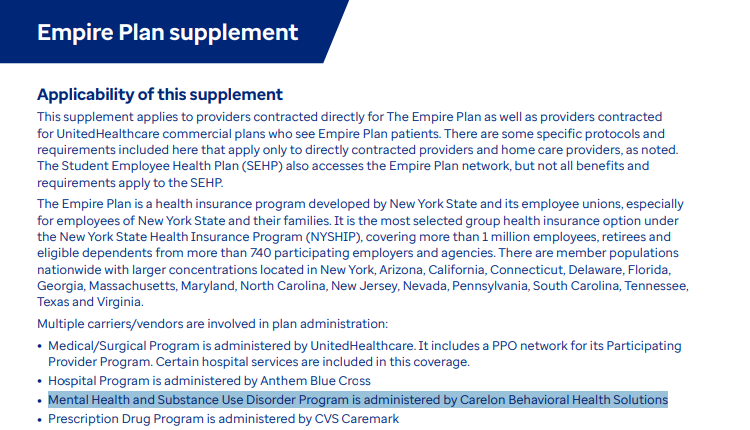
This kind of layered arrangement is more common than most practices realize. New York’s own Empire Plan is a real, documented example: UnitedHealthcare administers medical and surgical benefits, but mental health and substance use services under that same plan are actually handled by Carelon Behavioral Health, a completely separate administrator. Denials that trace back to exactly this kind of routing confusion tend to get misdiagnosed as a coding problem when the real issue is that the claim never should have gone to the primary insurer in the first place.
The real financial risk inside private insurance mental health RCM
Retroactive clawbacks are one of the more devastating surprises a small practice can face. One solo provider described an insurer retroactively terminating a former client’s coverage a full 12 months back, then demanding several thousand dollars in repayment, despite the practice having verified active coverage throughout the entire course of treatment. Federal protections do require health plans to keep provider directories and coverage information accurate, but that requirement doesn’t undo the financial exposure once a payer decides months later that coverage was never actually valid.
Credentialing and contract-rate disputes can escalate even further. One supervised therapist described their small group practice receiving a BCBS overpayment demand of more than $50,000, with the therapist personally told they might owe more than $4,000 of it individually. The practice attributed it to a retroactive rate change rather than any documentation error. That’s one provider’s account and should be treated as anecdotal rather than a documented industry pattern, but it captures the genuine financial fear that comes with payer contract changes and recoupments in this space. Knowing how to actually appeal a recoupment demand matters enormously in exactly this kind of situation, rather than assuming the balance simply has to be repaid as billed.
Same-day billing conflicts add another layer of unpredictability. One group-practice therapist described a client seeing both a therapist and a psychiatric medication provider on the same day, only to have one of the two services go unreimbursed, effectively leaving that clinician providing a session for free. That’s not a universal rule across every plan, but it shows how a single commercial plan edit can create real, unexpected revenue loss on a claim that looked completely routine.
What effective RCM looks like for solo providers versus practices
The right fix genuinely depends on practice size, since the underlying complexity scales differently.
| Solo providers | Group practices |
|---|---|
| Usually not enough complexity to justify full RCM services | Complexity multiplies through enrollments, credentialing, and verification work |
| Biggest fix is accurate upfront benefits verification, including who actually administers the behavioral health carve-out | Requires a maintained payer matrix and active credentialing tracking |
| Understanding payer rules before the first session prevents most downstream headaches | Denials become genuinely hard to track and root-cause without dedicated attention |
| Manageable without specialized RCM support in most cases | Requires proactive billing rather than reactive cleanup after the fact |
For solo providers, upfront payer research on every new client, confirming exactly who administers the behavioral health benefit and what their specific rules are, solves the majority of these headaches before they start. For practices, getting this wrong becomes expensive or time-consuming fast, and the practice ends up sacrificing one of two things: enormous amounts of staff time spent chasing down fixes, or simply giving up and accepting the write-off as lost revenue.
Why private insurance mental health RCM requires different expertise than other specialties
Mental health billing hides a trap that other specialties don’t share. Cardiology, for example, demands deep, specialized coding knowledge to get claims right. Mental health uses the same small set of simple codes across almost every encounter, which creates the illusion that billing here should be simple too. The real complexity lives somewhere else entirely: in payer-specific carve-out policies, denials that stay deliberately vague, and structural issues like supervision billing rules that vary from payer to payer. As that complexity grows, a specialized team built specifically around mental health RCM becomes less of a nice-to-have and more of a real necessity.
The high-deductible surprises that add up fast
High-deductible plans create a distinct, painful category of problem. One therapist described having to tell clients they suddenly owed $115 to $160 per session once claims processed against an unmet deductible, describing the toll of delivering that news repeatedly as genuinely difficult to carry. Another provider described clients discovering the same problem even later, sometimes only after they already owed $300 to $400, at which point some simply stop therapy altogether because they can’t afford to continue.
Independent, third-party audits are one of the most effective ways to catch these patterns before they compound into exactly this kind of outcome. Real visibility into where carve-outs, clawback risk, and deductible surprises are actually hiding is what separates a practice that’s genuinely in control of its billing from one that’s simply hoping nothing goes wrong.
Wondering how much of your own revenue is exposed to carve-out confusion, retroactive clawbacks, or deductible surprises you haven’t caught yet? Schedule a brief call and we’ll walk through where your private insurance billing is most likely at risk.